A “Neighboring Revolution” Is Under Attack
NOTE: This article was originally written in October 2023, but sadly is once again relevant as a new military assault interrupted peace talks on January 8, 2026.
Today we are releasing an emergency blog post and podcast as one of the most globally important examples of neighbor power and possibility is under military assault, as the new Syrian government’s army invades lightly defended Kurdish neighborhoods in Aleppo. The linked podcast is a 2023 interview with Samantha Teal, a media activist on the ground in North and East Syria, but this blog post will give some extra background and provide a more recent update to a very complex situation.
Let me give a content warning from the beginning. While this post, like all of them, will certainly cover some inspiring examples of beautiful neighbor-to-neighbor relationships and self-organization, I (Ian) am also covering topics of military occupation and invasion and all the horrors of war and injustice. Please prepare accordingly, but if you can come back to this, please do because this story needs to be heard, especially among people who live with relative peace.

Neighbors in the North East Syrian city of Qamishlo meet on their block to organize their lives together. Image source unknown.
On The Neighboring Movement podcast, we are starting an international neighboring series to stimulate our imaginations. If people really started to take neighboring seriously, if people started discovering, connecting, and mobilizing the gifts of neighbors right on their blocks towards their shared common dreams, what worlds are possible? Who is doing amazing things in neighboring in their contexts that we can learn from? Every locality and culture has its own specific context and radical experiments like the one this article will focus on often arise from truly desperate circumstances so we cannot and would not want to hold up examples from other places as exact replicas.
That said, sometimes seeing examples from other places that see the same stars in the night sky as we do can give us an idea of what is possible. For several years now, I (Ian, representing only myself) have been in dialogue with civilians, organizers, and officials from North and East Syria, helping connect them to similar movements around the world (ie. the Neighborocracy movement in India) that are organizing drastically new social arrangements which intentionally disperse power to assemblies of neighbors and average citizens, especially women. These people are doing incredible, courageous, difficult work and their resilience has given me so much hope. They refer to me as a heval, which is close to meaning “friend” but gives a deeper connotation of a relationship that is born of shared struggle for freedom and justice.
Sometimes the greatest beauty can come out of the most dire circumstances. The autonomous region of North and East Syria is generally considered one of the safest, and definitely the freest, region in all of Syria. This is thanks to an almost unthinkably bold social revolution that has emerged from under the shroud of the darkness that has faced Syria as a whole since 2011.
When many Americans look at Syria, they think ISIS, the most brutal fanatical terrorist organization we have seen in our lifetimes. The Islamic State (ISIS or pejoratively called "Daesh") once held massive chunks of Syria and Iraq, spreading fear and atrocities with each advancing step. Such horrific evils, however, were matched, to the surprise of Western eyes, with its equally formidable diametric opposite. A bottom-up, women-centered democracy was budding simultaneously and laid down a line that Daesh was unable to cross. Headlines and press photos showed courageous all-women's and mixed-gender units of young fighters tearing through the ISIS lines. The global media followed a little-known militia made up of Kurdish former mountain guerrilla fighters, Arab tribespeople, and Christian villagers, known as The Syrian Democratic Forces (SDF), from a last-ditch defense of the besieged border town of Kobani to their capture of every last inch of ISIS’ territory in Syria in just a few years. While they aired plenty of war footage, the journalists rarely dug deep enough under the surface to see the remarkable multi-ethnic social forces that propelled this resistance.
Communities of Kurds, Assyrians, Arabs, Armenians, and Yezidis in North and East Syria (colloquially called "Rojava") have spent the last 11 years dealing with far worse versions of the uncertainty and precarity we are just now beginning to face with our price hikes, climate disasters, and supply chain shortages. They turned to their neighbors to get themselves through civil war and ISIS attacks, and are emerging through it all with a renewed society that is far more beautiful and far more free than they had before. It’s a story of hope and I think it is very instructive for us about the possibilities that can emerge from a crisis like a pandemic, natural disaster, or loneliness epidemic when neighbors start to become conscious of themselves as a network of shared survival.
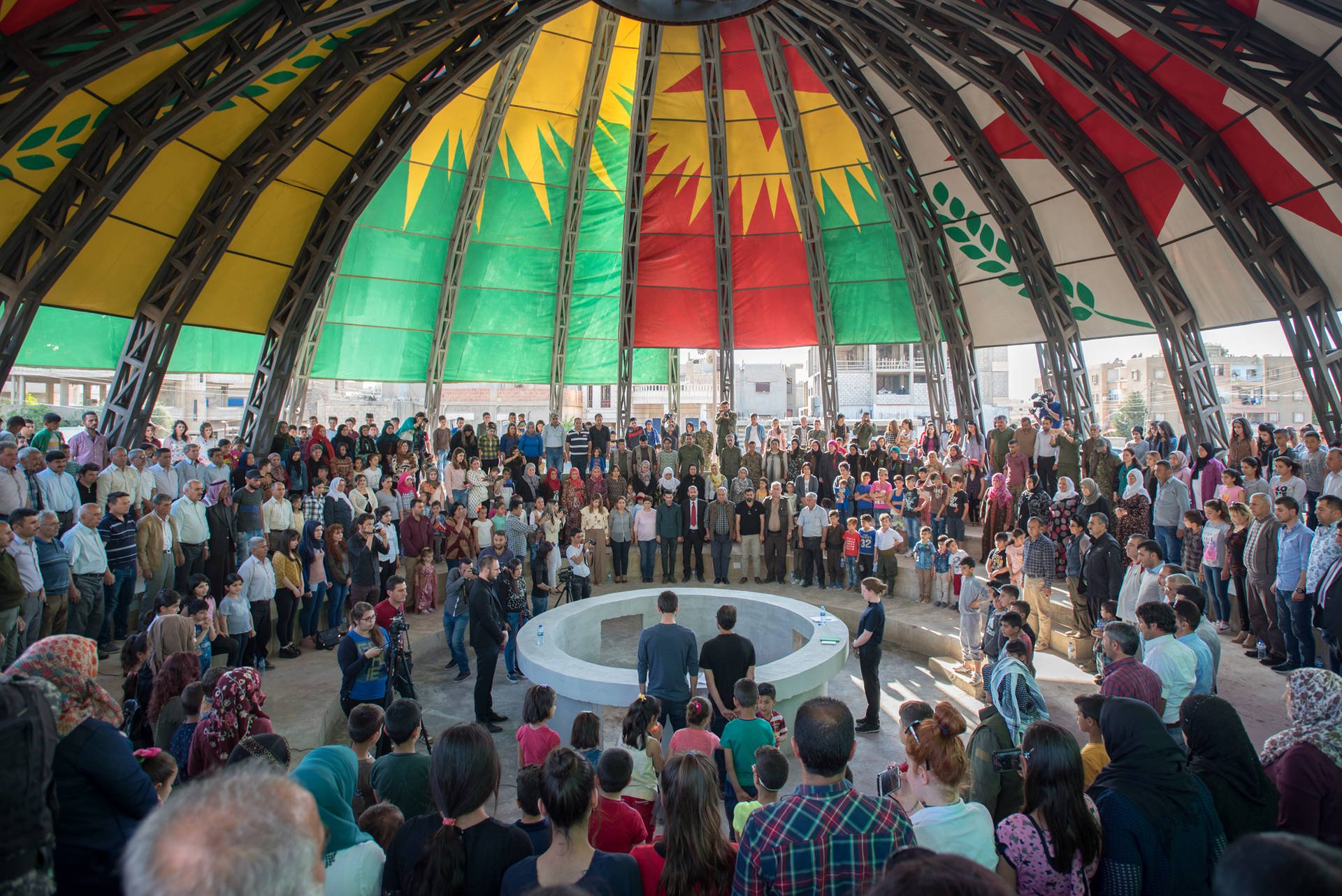
Neighbors make many decisions in assemblies and send delegates to voice their points of view to larger meetings like this one.
This is where this revolution becomes especially relevant to The Neighboring Movement. The Democratic Autonomous Administration of North and East Syria (DAANES), the region’s official name, can be called “a democracy of neighbors.” Controlling 1/3 of Syria, their system gives us a glimpse of what it would look like if the most important hub of democracy was intentional assemblies of neighbors, gathered together block-by-block, street-by-street, apartment unit by apartment unit to celebrate life together, share together, discuss together, decide together, and act together in a fully-inclusive, fully participatory manner. At its best, it is a picture of a life freed from deeply divided, hyperpartisan national politics far removed from the realities of everyday people.
Instead politicians and government obey and convey: they are given specific instructions by their street and neighborhood assemblies which they convey to the next level of representation- towns, cities, regions, and the Autonomous Administration as a whole. Power flows from the bottom-up, in theory and increasingly in practice, allowing the vast majority of the decisions that affect the lives of the people to be made directly by the people themselves. But there would be no way for people to deliberate over those decisions, come to agreement on them, enforce them, and protect them if they did not spend decades quietly rebuilding their social fabric- a strong, interwoven network of neighbors dedicated to taking care of each other and connecting and mobilizing their talents and assets, one block at a time.
But let’s take a step back. In the 1970s and early 80s, the Kurdish people who would eventually catalyze what is called the “Rojava Revolution” were far from an interwoven network. Yes, they had a rich communal culture and heritage that elders could remember and try to keep alive, but after a hundred years of constant oppression from four different nation-states that trapped Kurds in the middle, they were facing a state of what their leading theorist Abdullah Ocalan called “societycide.”
State powers had so pit Kurds against Kurds and other cultures against Kurds (really neighbors against neighbors) that the once-vibrant and communally connected society was on the verge of non-existence. Four nation-states had been built right over the traditional homelands of Kurdish people: Syria, Turkey, Iraq, and Iran. Kurds were variously denied the ability to speak their language, sing their songs, denied their very existence as a category in some states, barred from citizenship in others, and even prevented from growing fruit trees or having any of their own means to sustain themselves. Forty years ago, oppression and fear were rapidly draining Kurds and other marginalized populations of what we call “social capital (the value that comes from strong communal connections).”
In the 1970s however, Kurds started fighting back against their oppression, sometimes making common cause with other oppressed minorities such as the Assyrian Christians. One manifestation of this fight was with armed guerrilla groups, but there were vastly more people engaged in organizing a healthier day-to-day civilian life. In Northeast Syria, activists and families spent decades secretly and illegally organizing support structures to fill the gaps that the state left in their communities. Eventually, their homegrown ideology of Democratic Confederalism won favor among many different ethnic groups in the region.
Democratic Confederalism is a kind of hyperlocal direct democracy where local people band together to meet their needs themselves and ultimately make the states that have left them out to dry obsolete. It emphasizes ethnic and religious pluralism, women’s freedom, and ecology, in stark contrast to priorities of the authoritarian states dominating the region. This is the background that takes us to 2012, when the Syrian government completely pulled out of Northeast Syria to fight a civil war in their major cities, leaving a power vacuum. That vacuum could have been filled by jihadists or aspiring authoritarians as in many parts of Syria, but instead the local people were able to piece together clandestine building blocks to govern their own lives in a remarkably smooth transition.
One of these building blocks became what they called “communes.” Despite the same name, the word has a completely different cultural connotation there from the “hippy communes” we might think of here. By commune, they mean a coordination of neighbors on the most local level, ideally less than 100 houses, but restrained by wartime conditions, often quite a bit more in practice. These neighbors pool resources, strengthen social life, and use direct democracy to decide on the decisions that most affect the people that live there. Neighbors are all welcome and encouraged and trained to participate in the commune, the most important political entity in the society. This makes neighbors, not politicians, the most important political actors of North and East Syria.
All of the 5 million or so inhabitants of the region can theoretically practice direct democracy through local communes where they live. These communes federate into councils at all the various levels of society so that power flows from the bottom-up. In conditions of war, many communes were lacking in practice, only slowly gaining acceptance with a population used to the old Syrian regime who made all decisions for them. As a fragile peace has mostly held in the wake of a truce and ongoing peace talks between the DAANES and the new regime that ousted Assad across the rest of Syria in 2024, there are ongoing intentional efforts to increase participation in the communes and ensure that everyday residents hold real power. In 2023, the DAANES, after a long consultation process with large swathes of the civil society, ratified a new social contract that laid out in formal writing the bottom-up system that had already been in progress for years. The Social Contract lists the communes first and foremost among governance units, and its emphasis that the neighbor-led decisions cannot be contradicted shows that this is truly designed to be a democracy where neighbors, not politicians or businesspeople, are the key decision makers.
So what kinds of decisions and actions might neighbors take in their communes? Here are a few examples modeled off of my film, The Communes of Rojava: A Model in Societal Self-Direction.
Through economic committees, neighbors have formed hundreds of worker and neighbor-owned cooperatives across NES that incorporate many or even all the people of local communes in the work and decisions. Examples include cooperative restaurants, retail stores, vegetable canning factories, and energy cooperatives.
Economic committees might also buy essential food items in bulk directly from producers for much cheaper, or they might work with agricultural committees to help build gardens or farms
Through safety committees, neighbors select two among them, a man and a woman, to be societal defense forces for their block. They are not to be vigilantes, but instead they seek training in de-escalation, conflict resolution, and other safety skills and then train their other neighbors in these things too so that safety becomes the responsibility of all. "Each one, teach one."
Neighbors go through emergency preparedness courses together and co-create a plan and roles for use in various types of disasters.
Peace and Consensus Committees are made up of trusted neighbors who are trained to mediate disputes.
Health committees train all residents in basic first aid and other vital health skills that increase neighbors’ ability to depend on each other.
Neighbors might pool funds for special celebrations, scholarships, emergency health needs, or funerals.
Communes organize regular skillshares where neighbors can share their talents with others, hoping to increase the breadth of knowledge and skills with everyone.
Communes put special emphasis on highlighting the unique gifts that each culture represented on the block brings to the neighborhood tapestry: celebrating each other’s holidays, learning each other’s languages, and sharing each other’s food and stories.
Women’s committees in every commune have autonomous say over the most crucial decisions affecting women and ensure women self-organize for their safety, health, education, culture, and economic self-sufficiency.
From its communes and councils upward, the democratic confederalist system has proved remarkably resilient, powering the defeat of the once-unstoppable ISIS caliphate. This system has weathered myriad threats including full-scale invasions by the Turkish military, embargoes, relentless attacks on infrastructure, drone assassination campaigns, natural disasters, the COVID-19 pandemic, water wars, tribal conflict, legitimate criticism, internal prejudices and oppressive attitudes, spillover from other regional conflicts, wildfires, and so much more.
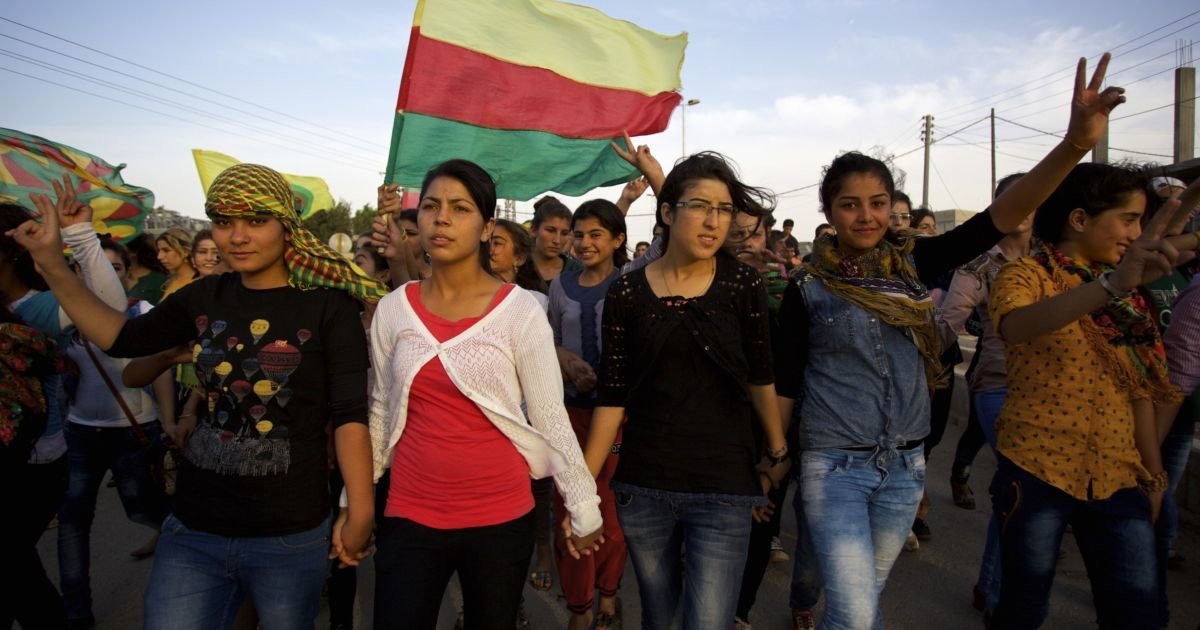
Women march in a popular demonstration. (Photo by: Andia/UIG via Getty Images)
So what does this have to do with The Neighboring Movement? It has less to do with this organization proper, than it does have to do with all “neighboring movements” around the world. Anyone who believes in the power and promise of neighboring, who believes that average people should be able to participate directly in the decisions that affect them, that all ethnic groups and cultures and religions should celebrate their diversity, that women and ethnic minorities should be able to self-organize with equal/proportional representation, that democracy is about far more than ticking a box by one of two candidates’ names every four years, should care deeply that the most imagination-expanding revolution maybe ever is at a dire crossroads.
Since late 2024, the new Syrian government in Damascus has been granted remarkable international legitimacy despite the fact that its appointed president once fought for Al Qaeda against Americans. The government gained power of the majority of Syria after a surprise defeat of the former Assad regime as 2024 closed. The international community had long opposed the Assad regime’s massive human rights violations, and was tired of war, and wanted to get on the ground floor of diplomatic relationships with the new regime. The new government, though made composed of former Al-Qaeda affiliates promised to be kind to minorities, stop threats to Israel, and open Syria up for Western investment. Hope abounded at first: Assad was gone, prisoners held in dungeons for decades were ceremoniously freed and reunited with their families, and minority groups were cautiously optimistic.
Within months though, the Syrian Transitional Government’s militias perpetuated horrific massacres against thousands of civilians in two enclaves held by Alawite and Druze minority groups, respectively, in other parts of Syria just this year. The massacres happened with international attention, many killings were shared via social media, and the primary perpetrators were from the same militias that Turkey has used as its main ground troops in invasions of North and East Syria. Each time, the government claimed to have nothing to do with the massacres and to be investigating and arresting the perpetrators.
The DAANES, whether caught up in the cautious optimism, generally fatigued by the war or facing international and internal pressures, turned to the negotiating table. Though the defense forces (SDF) of the DAANES were America’s number one ally in the defeat against ISIS (US general Jonathan Braga called the joint effort “one of the most successful indigenous-force partnership relationships in US military history”), American political priorities have changed and the Trump administration, along with Turkey, is demanding SDF integrate into the Syrian state. The freedom movement in North and East Syria, for their part, demands a decentralized Syria that would allow it to keep much of its autonomous structures while formally integrating.
Negotiations began in early 2025 and coincided with a major peace process in Turkey between the state and the Kurdish movement there. Since then, Turkey has mostly halted its drone strikes, and has not interfered as influential Kurdish figures have traveled freely and met together across borders for the first time. At the same time, Turkey set a December 31, 2025 deadline for full DAANES integration into the Syrian government, using hostile language, demanding disbandment of the SDF, and threatening war. Negotiations made slow progress, and the movement’s two Kurdish neighborhoods under its control in an otherwise regime-held Aleppo became the testing ground for broader agreements. In April, the SDF agreed to pull its military forces out of the neighborhoods while leaving civilian police forces and its political councils there to cooperate with the regime’s forces who would remain outside of the neighborhoods. There was hope that this could appease everyone, allowing some autonomy and reducing contact between the SDF and regime military. Instead, reports from Al-Monitor revealed that during US-mediated negotiations on January 4th, the regime’s foreign minister abruptly entered the room and asked the mediators to leave, saying negotiations were over and could resume on January 8th. By that time, the Syrian government had launched a full-scale military assault on the now lightly-defended Kurdish neighborhoods, calling for their full surrender. While the attacks are an abrupt threat to negotiations, the Al-Monitor report hints that they may have been planned by Syria and Turkey months ago.
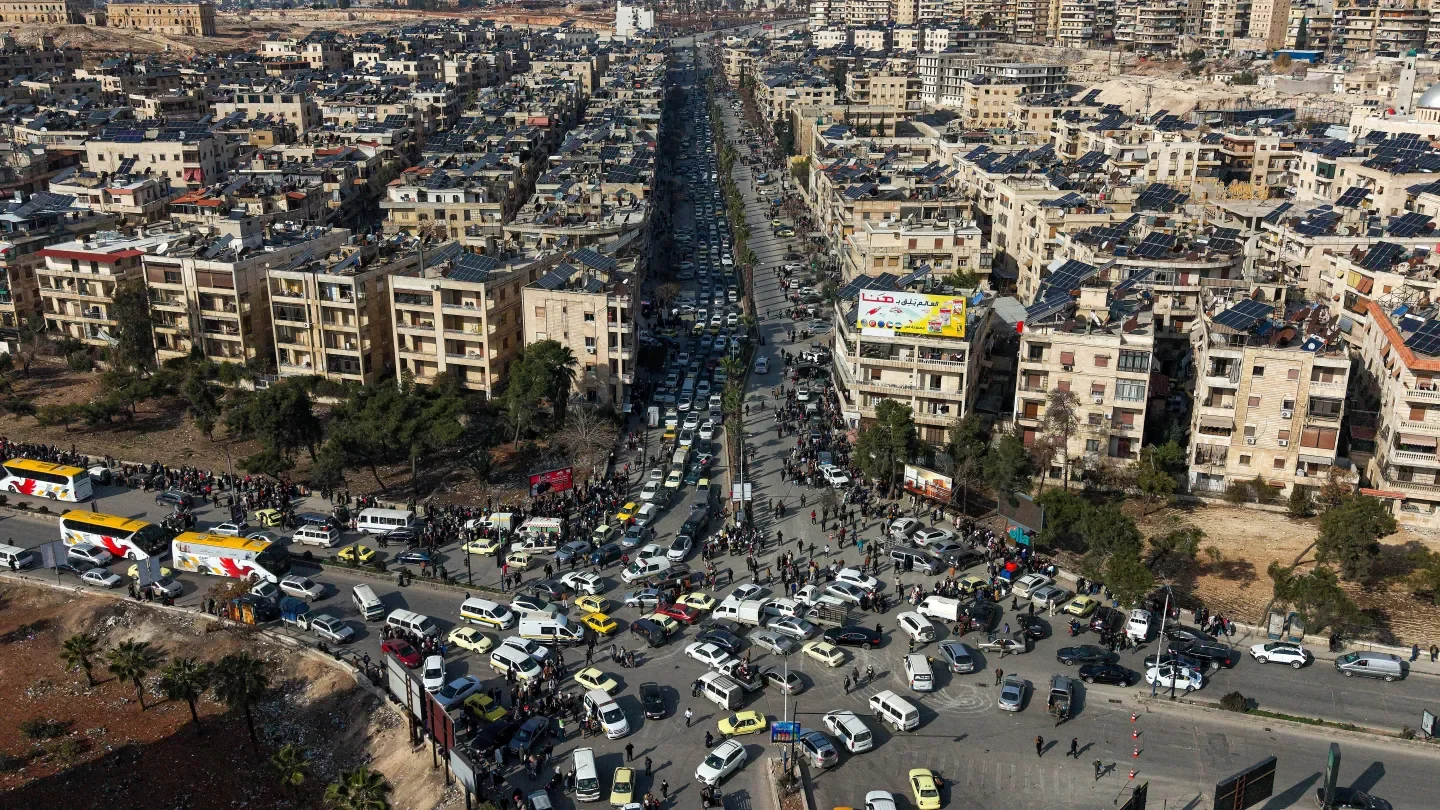
Residents flee from Kurdish neighborhoods after attacks in Aleppo, Syria, Wednesday, Jan. 7, 2026. (AP Photo/Omar Albam)
The Syrian regime and Turkish government are demanding full capitulation of the democratic confederalist project, folding all institutions into the centralized state. This will likely damage the peace process in both countries. The SDF, including its mixed-gender and all-women’s units, have refused any future in which they lay down their arms or integrate into the Syrian army in any other way except as full, autonomous units. The neighborhood security forces in Aleppo have decided to fight as long as they can hold out. The freedom movement argues that the only viable future is one in which its enemies will have to acknowledge its gains as a real, unchangeable fact. They argue that centralization will create a Syria that is just as oppressive as the one ruled by Assad that so many millions gave their lives in rebellion against. They continue to insist on negotiations and peace in Syria that is marked by respect for diverse identities, religions, and ways of governing local areas.
The friends that I have met from North and East Syria, the Kurdish people and their Arab, Assyrian, Yezidi, and Armenian friends, and all those who organize as part of “democratic confederalist” movements around the world are the most resilient, hopeful, welcoming, and creative people I have ever met. Because they have zero doubt in their mind that their movement and people can navigate this peace process and the ever-looming threat of war if negotiations break down, I have zero doubt, too. And yet, any more bloodshed in Syria will come at a tremendous cost to freedom, stability, and a just future. Without a DAANES, a testament to the human capacity for resistance, for pluralism, for grassroots democracy, for women’s liberation (at levels not seen anywhere else in the world) will be lost. We in America have everything to learn from them, and the threats and attacks are designed to make us forget. Yet these movements and storied peoples will endure. We can all play our part in making it easier for them. Nothing boosts morale like a sense that others across the world are struggling alongside them.
This movement is very much in need of ongoing support, and there are many ways to help. You can call your representatives and remind them that 11,000 SDF fighters gave their lives to defeat ISIS when no one else could and that they deserve our tangible gratitude. You can donate to their local relief organization Heyva Sor, support the US-based Emergency Committee for Rojava, or even organize a zoom meeting between your neighbors and civil society organizations in North and East Syria for mutual friendship and education.
But even more than that? You can organize your neighborhood: Time and time again, my friends in NES have told me that the best way to help them is to build on their example by imagining what a grassroots democracy of neighbors would look like in your neighborhood and then doing the work to bring it to life. When everyone can experience the collective freedom and responsibility (and joy, relationship, and abundance) that comes with organizing towards common dreams with one’s neighbors, they will be far more likely to want to protect others’ right to do the same. In America, we have to start by shifting our cultures slowly but surely towards cultures of neighborly interdependence. Here is one place to start.
To learn more about the inspiring commune system in NES, you can watch this short “documentary” I made 7 years ago. Ready to dive deep? Check out my follow-up video where I spell out my thoughts on how we can practically organize neighbor-based participatory democracy in the US.
Ian Campbell
The Neighboring Movement